Wednesday, 18 September 2013

Review: Kes at Derby Theatre.


Kes at Derby Theatre.

This production is adapted by playwright Lawrence Till from Barry Hines' novel – A Kestrel For A Knave and runs from Friday 13th September to Saturday 5th October.
 
The story of Kes concerns a 1960s Yorkshire schoolboy called Billy Casper who is bullied, neglected and misunderstood and, in the Derby Theatre production directed by Sara Brigham, Billy is played with great energy, passion and emotional subtlety by Sam Jackson. Billy is bullied by his older brother Jud (Jimmy Fairhurst) and emotionally ignored by his feckless Mother. As the story evolves we discover that Billy has been teaching himself falconry and devoting himself to his found kestrel wherein he finds a personal peace, an unbridled excitement and a purpose in life. The kestrel training is a challenge to the young man, a hard won reality and also infers a deep desire for personal freedom and an attempt to find himself in amongst the cruelties he encounters at school and in his family life. On the positive side Billy's character is transformed when he speaks to the school class and to the audience about his love of the wild kestrel he has named Kes and he is solely supported by an English language teacher, a Mr Farthing, performed with great compassion and conviction by John Elkington.

Jackson is especially strong in the heart breaking scene where he confronts and fights his useless Mother and nasty brother Jud and later on when he breaks into an abandoned cinema and pours out his feelings to his absent father who he imagines up on screen. The emotional truths and the teenage frustrations are brilliantly handled and conveyed on stage.
 
In amongst the darker elements of the play are lots of laughs during the school scenes – Paul Clarkson is perfect as the controlling 1960s headmaster and Andrew Westfield is hilarious as the menacing but rather thick PE teacher, Mr Sugden. The laughs work on two levels: the genuinely funny plot and actions/reactions and also on a nostalgic level for those in the audience old enough to have been a school child themselves in the 1960s. The local children playing the school kids are terrific and thoroughly believable in their parts and they work very intuitively in the choreographed ensemble movement although each retaining an individual personality within the group. The professional actors playing two of the schoolboy speaking roles (Thomas Pickles as Tibbut and John Holt -Roberts as the bully MacDowell) are excellent. If a production of One Flew Over A Cuckoo's Nest ever came up Pickles would be a perfect casting as Billy Bibbit.

Samantha Seager as Billy's estranged Mum – Mrs Casper – is extremely exasperating in her selfish reluctance to offer Billy love and support in his moments of deepest need and plays the unsympathetic role with great conviction. Nova Skipp is utterly brilliant in her very different roles as the teacher Miss Fenton, Mrs MacDowell, Librarian and Miss Rose. As far as the audience are concerned each character she plays could well have been a different actress performing.

The whole piece is a terrific example of ensemble playing and the very moving Derby Theatre production is to be thoroughly recommended. The simple setting and use of panoramic back projections coupled with a dynamic musical score by composer and sound designer Ivan Stott really enhance this play and the whole package makes for a wonderful night at the theatre.

Phil Lowe.

Tuesday, 23 July 2013

Review: The Ashes. Nottingham Playhouse

Originally written for The Public Reviews
 
'The Ashes' by Michael Pinchbeck was first produced at Nottingham Playhouse in September 2011 and has been revived to coincide with this year's Ashes test at the Trent Bridge cricket ground in Nottingham. The new version is designed in a different light from the original, principally through the author Pincheck's initiative to contact Harold Larwood's daughter Enid Todd, who now resides in Australia. Their conversations helped the playwright to develop the role of Lois, Larwood's wife.

For any playgoer having seen the 2011 original there are some excellent changes in the projected cricket footage used creating an improved dynamism and focus on the central relationships.

The director, Giles Croft is an active promoter of new theatre writing at Nottingham Playhouse and the East Midlands and in the case of 'The Ashes' he feels that this new production offers a wonderful opportunity to add new scenes and tone to the work and build upon any success the play may have at and outside of this revival at Nottingham Playhouse.

The play of 'The Ashes' tells of the controversy surrounding the 1932-1933 England cricket tour of Australia. The tour was made famously controversial by the dangerous bodyline bowling tactics employed by the England team, in particular the fast bowler Harold Larwood. The events led to a crisis of diplomatic events between England and Australia.


Karl Haynes is very authentic as Larwood as both a younger and older man and his Nottinghamshire accent is perfect. Larwood and his fast paced, fearless reputation for accuracy and speed were legendary but his 'un-sportsman-like' heroics were also his downfall and after his refusal to apologise he never played for England again. Later in his life however, he was welcomed to Australia when he chose to go and live there.

The play boasts six actors, Michael Pinchbeck, Karl Haynes, Robin Bowerman, Sarah Churm, Jamie de Courcey, Daniel Hoffman – Gill, Timothy Knightley and Paul Trussell, some playing multiple roles with various accents and the piece is very much an ensemble piece with an almost bare stage setting the scene for the threads of the story. The stage is very well used and the story telling aided with clever and regular usage of projections of titles, stills and film archive. Occasionally the actors copy the actions of the characters on the archive films with great theatrical results, skill and humour. The only female in the cast, Sarah Churm, plays Larwood's wife Lois and some humour is had with her playing several cricketers alongside the film running above. She is also very poignant in the scenes where she watches sports newsreel footage in Mansfield of her husband the England team thousands of miles away in Australia.

Overall there is some superbly understated acting and great direction from Giles Croft. Even if one isn't a cricket fan it is the human dramas that lift this play well beyond the boundaries of 'just a play about cricket.

Phil Lowe

Tuesday, 25 June 2013

Review for Blue Remembered Hills at Derby Theatre June 2013


Dennis Potter's play 'Blue Remembered Hills' is a story about the past, the present and the future and follows the lives of a group of seven year old children experimenting through boisterous play to make some sense of the world around them.

The play is set during World War II and the children are discovered playing in the idyllic setting of the Forest of Dean on a beautiful summer day in 1943. They play, they taunt and fight and define relationships with each other by bickering and bullying to be top dog. There is also a great sense of fun and hilarity to be had as the children play their games and build complex friendships. Then in the midst of the play one tragic event changes the way they look at life forever.

Ruari Murchison and Colin Grenfell's stage design of an imposing dark grey hill and blank screen onto which the shadows of trees are cast works well with this version and the potent musical score (Olly Fox) serves well to add several layers of story telling enhancement and drama.

Director Pysche Stott believes that Dennis Potter's play is not only a piece that describes human capability for brutality, namely, the children’s relationships and the major world war going on in the adult world, but also about the human capability for joy, pleasure and wonder. And it is all these attributes that come alive on the stage with the seven children being played by adults – the remembered – aspect of the story.

All the cast work brilliantly as a team and the 'child-like' and childish personalities are superbly drawn. This, to quote Dennis Potter, is “childhood defined as the adult society writ large without all the conventions and the polite forms which overlay”. The work on the stage in Blue Remembered Hills at Derby Theatre has a fluidity and creative freedom and above all boldness and daring and makes for very fulfilling theatre. It is often extremely funny with darker undertones.

At the centre of the piece Christopher Price shines as the cruel and bullying Peter. James Bolt gets the sympathetic note as the stuttering, cowboy outfit wearing Raymond and David Nellist is terribly funny as the non- judgemental boy called Willie who just wants to be loyal and fair to all and is obsessed with Spitfires.

Tilly Gaunt portrays the sniffy Angela to perfection, at once vain and childishly superior, her deeper insecurities are subtly demonstrated though her interpretation. Joanna Holden as Audrey brings a real sense of tenacity to her character and is a wonderful comedian. Adrian Grove moves emotionally as the maltreated Donald who is desperately missing his father and Phil Cheadle portrays his character with a quiet authority and is particularly impressive in his scenes standing up to the bullying Peter. The whole piece has great energy.

The late Dennis Potter wrote 'Children are as intense in happiness as they are in misery. They live in the moment. That's the art of living that most adults have lost. Remembering how to live in the moment and why it might be important to do that as adults.'

This play is chock full of those important moments in our lives and an unforgettable evening at Derby Theatre.

Phil Lowe

Thursday, 13 June 2013

Derby Theatre Summer School. Want to get involved?


Derby Theatre Summer School
 
PLAY IN A WEEK


Monday 29 July – Friday 2 August


For one week over the summer holidays;
Derby Theatre will run a Summer School
of theatre for 8 – 16 year olds, where they
will produce a
Play in a Week, from Monday 29th July until Friday 2nd August.

During this exciting summer project, young
people will work in a real theatre setting, with
professional theatre practitioners, to create
a play in just one week.

For young people with an interest in theatre this a great opportunity to: work with professional theatre practitioners, share ideas and put them into practice and performance, gain an insight into producing a show within a professional theatre environment, be involved in the production, and be a part of the decision-making relating to how the play develops. The end product will be a live performance, shown to family and friends, on the final day. Caroline Barth (Head of Learning, Derby Theatre) said:“We are really excited about working with the talent and energy of young people of Derby and Derbyshire.  Our professional theatre practitioners will work with the group to make a performance to share for friends and family.  This is a great opportunity for everyone, from young people who haven’t been involved with us before to those who would like to develop their passion for theatre.”

There are a total of 50 places available (25 for 8-11 year olds and 25 for 12 – 16 year olds). Interest in the summer school is expected to be high; so early enquiry and booking is recommended. The whole week costs £65 per person.

To book a
Derby Theatre Summer School place: email Matt Clay at: m.clay@derby.ac.uk. For further enquiries, including information about limited subsidised places that may be available to certain young people, contact Caroline Barth, Head of Learning at: c.barth@derby.ac.uk

Wednesday, 12 June 2013

Review of The Seagull. Derby Theatre.


Review of The Seagull.
 
11th June 2013

Derby Theatre


Anton Chekhov's 'The Seagull' is deemed to be one of the great modern classics and Headlong Theatre and The Nuffield Southampton co-production with Derby Theatre excel in bringing a bold freshness and modern approach to the work through John Donnelly's stunning up to date version directed by Blanche McIntyre. The original ideals of ground breaking theatre written by Chekhov were that the language be direct and have immediate meaning for the audience. Instead of stilted overly theatrical language Chekhov's dialogue and theatrical prose were seen to be startlingly fresh and understood by the audience as 'the language we speak ' or the actions and flow of story 'the way we live now'. These were challenging and exciting concepts that changed the future of theatrical art and how a story is presented on the stage.

Theatre and art are discussed at length through various forms and clever staging in this piece and quite intensely at some points, brilliantly turning a tirade into a sexual turn on for one character. A bold and amusing approach to interpretation. Boris and Nina fiercely argue the pros and cons of artistic success and the naïve Nina succumbs to the magnetism of the successful but unhappy Trigorin both balanced on a rocking sea saw of wild emotions.

The piece could be called a 'movable artistic feast' with the ultra modern symbolic set that isn't traditional in any sense only depicting a change in place through new positioning; a fresh off kilter imbalance of levels and the introduction of hastily drawn suitcases or indecipherable writings on the backdrop. The production was certainly atmospheric and the score electrifying at times and the quality lighting palate that sometimes illuminates the audience as well as the players created tensions as well as the scene. As a piece of theatrical live art it worked well and the acting was top class, on the whole, thrillingly mixing seasoned actors with raw new talent fresh from drama school.

Phil Lowe


Thursday, 30 May 2013

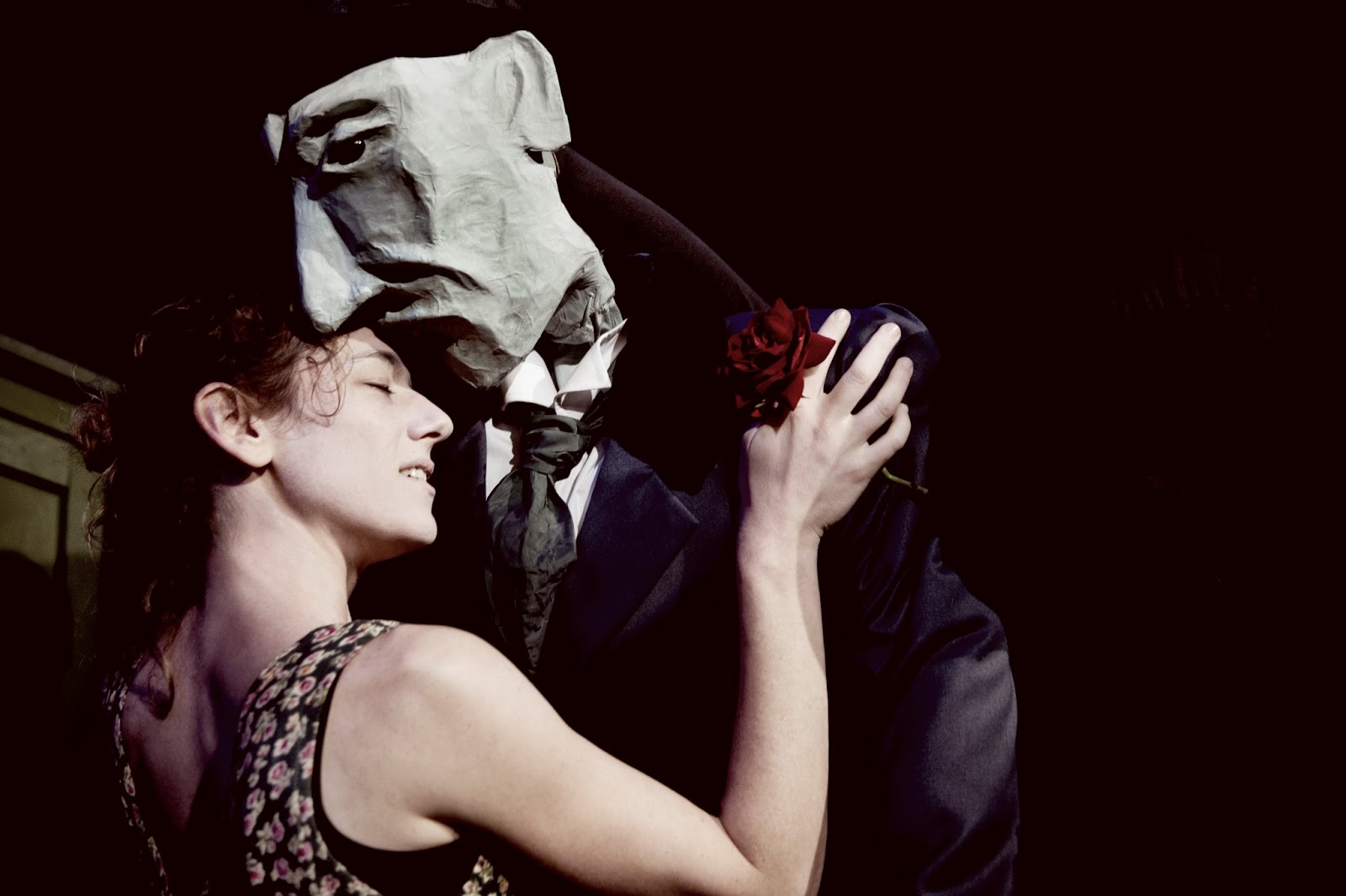
The Fantasist by Theatre Témoin at Derby Theatre Saturday 15th June. Promotion.

Theatre Témoin present THE FANTASIST  Derby Theatre - STUDIO Sat 15 June  
A stunning exploration of the  glorious heights and murky  depths of bipolar disorder. 
As part of a nationwide tour, from Cornwall to Scotland, the 5 star-rated production of The Fantasist, presented by Theatre Témoin, will show in the Studio at Derby Theatre for one night only on Saturday 15 June.  

“Astonishingly powerful” Fringe Review 


Stunning life-size puppetry, created in collaboration with War Horse’s Robin Guiver, combines with object manipulation, physical theatre and original music in this highly imaginative, surreal and disturbing story of a woman battling bipolar disorder. Informed by medical experts, The Fantasist emerges as part of a wave of puppetry that is growing exponentially since the West End success of War Horse and similar highly visual puppetry shows. Touring the UK as one of the sell-out successes of the Edinburgh Fringe 2012, the unique and hypnotic visual style of this production explores a deeply personal story of mental illness to powerful theatrical effect.  


The Fantasist runs alongside Mental Health Awareness week 2013 (May 13-19). It was developed between 2011 and 2012 from personal experience and medical research with the North East London NHS Foundation Trust (NELFT). The lead performer has been a carer for her mother throughout her adult life, and has direct experience with the extremes of bipolar disorder. The personal story behind this play has helped it become a vehicle for approaching the taboo subject of mental illness in a way that is non- didactic, funny and theatrically exciting.  


In the mind of the fantasist, the real and the fanciful become dangerously blurred. As Louise gazes into the night, her fancy takes form. Objects move, time changes … and a seductive stranger opens up a world of exhilaration and magic. But everything comes at a price… 


Tickets: £9, concessions £6. For more information and to book tickets call the Box Office on 01332 59 39 39 or visit www.derbytheatre.co.uk

Wednesday, 29 May 2013

Review of The Pitman Painters by Lee Hall. Derby Theatre.

Derby Theatre 28th May -1st June.

This rightfully acclaimed play by Lee Hall is on tour and arrives on the Derby Theatre stage shortly after the very successful production of Hall's other masterpiece 'Cooking with Elvis' and is enjoyed by a packed audience.


The Pitman Painters is based on a true story of a group of coal miners in the 1930s who embark on attending an evening class to study art appreciation. In the original group there were around forty attendees but for the theatrical version of events Hall has condensed the group down to five miners of varying ages and two women plus the art teacher. The play is set in Ashington in the North East but periodically travels down to London as the feted artist miners become well known and their paintings considered Modernist in style. The overhead projections of the art works that are created and critiqued, debated upon and discussed, all with innate intelligence and wit, add another dimension and knowledge bank to the play. The fantastic sound effects by sound designer Martin Hodgson bring the unseen and deafening noises of working men and ponies below ground very much to the core and fore of the piece. It is a play that educates, amuses and moves the audience every second of its vital performance and is acted to an extraordinarily high standard by the whole cast. There is nothing artificial in this artful show only human and artistic truths compellingly told.

The whole cast work as a seamless unit fluidly creating each scene within the body of the towering and stark industrial grey set. The half dozen folding chairs are used very imaginatively creating several new environments and become almost balletic in their shifting formats and percussion. The impressive set design is by former Nottingham Trent University graduate Gary McCann. Director Max  Roberts directs as Artistic Director and founding member of Live Theatre, Newcastle upon Tyne. The direction is exemplary.

 Louis Hilyer playing the art teacher Robert Lyon commands the stage through his energy and the character's artistic fervour and the light and shade of the actor's subtle depiction is very believable. All of the miners characters are very well drawn by writer Lee Hall and the particularly difficult local accent of the Ashington area brilliantly done by every man playing the miners. You feel as though you are an onlooker into their private male community. Nicholas Lumley as George Brown charms as the older man of the group at once strict and abiding by his book of rules and the next giggling like a bairn. Philip Corella as Oliver Kilbourn delivers an inspirational monologue about the nature of creativity and is convincing in his indecision of accepting a stipend to leave the mining the community and paint for a living. Riley Jones (Young lad and artist Ben Nicholson) moves easily between sympathetic to paint splattered but entrapped aesthete and is equally convincing each role.

Joe Caffrey and Donald McBride (Harry Wilson and Jimmy Floyd) are like chalk and cheese, the righteous  full on Marxist with a searing intellect and the gentle, dog loving  humourist playing off each other throughout with their own beliefs and  wit. Catherine Dryden brings out the wilful female in the aspirant life model Susan Parks and much laughter is had from the men's reaction to a potentially naked woman in their midst. Suzy Cooper is totally convincing as the art collector and patron Helen Sutherland. She carries the character with great poise and gives her a genuine warmth. Her disappointment at Kilbourn's choice of artistic journey is palpable.

"The Ashington Group", to quote Oliver Kilbourn, " were never a commercial group but preserved our idealism. We thought we were doing something that no-one else could do. We were depicting way of life below and above ground in a mining village that only we know by experiencing it. Life goes on and we paint life." This play explores the nature of art and the individual interpretation of the image through feeling and 'seeing as doing.'  It looks deeply at personal politics and Politics, at inspiration and aspiration and it succeeds. Another great success on the Derby Theatre stage.