Showing posts with label the lace market theatre. Show all posts

Monday, 14 July 2014

Features in Sardines Magazine plus Sharing the Successes in my theatre writing.

Looking back over the last twelve months of theatre reviewing and professionally writing about and for the theatre I have built myself a good reputation as an interesting and inspired writer. My sincere thanks to Heidi McKenzie of Derby Theatre and Jo McLeish of Nottingham Playhouse whose generosity of support has been invaluable during this time. Equally to Paul Johnson of Sardines magazine who saw something in my writing and encouraged me along the way. Lastly to Abigail Rhodes the editor of The Boards who made positive comments about my theatre based ideas for their magazine and encouraged me to submit my articles which were subsequently published.

As well as having the honour to be a regular contributor to the illustrious Sardines theatre magazine I have been out and about throughout the cities of Derby and Nottingham reviewing a plethora of professional plays and shows and interviewing major playwrights such as John Godber, Howard Brenton and Nottingham based playwright, Andy Barratt. Other interviews have included the cast of The Second Minute, Shobna Gulati and Joe McGann, Warwick Davis and Barrie Rutter of Northern Broadsides.


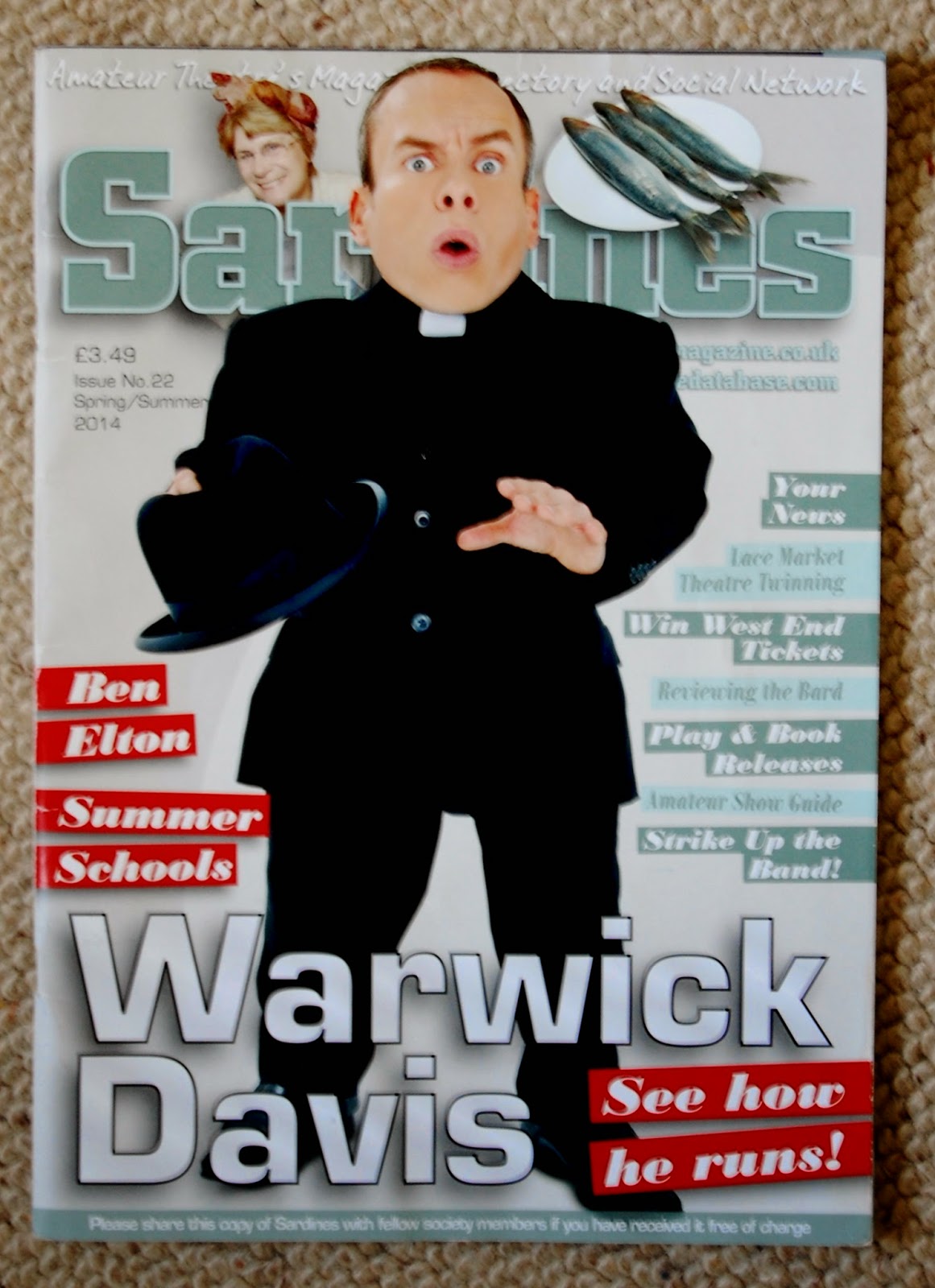
For Sardines I have had three articles published; the cover article and interview with Warwick Davis, a piece about my life as a reviewer and another three page spread about Nottingham's Lace Market Theatre's twinning history with two German theatre companies. This sharing of European theatre is one of my great passions.

Howard Brenton Photo by Phil Lowe
Also for Sardines I have been compiling articles, interviews and reviews connected with plays about and concerned with the centenary of World War One. The result (August edition) will be a twenty page spread of fascinating text that shows off the best of amateur and professional work across the UK accompanied by stunning photographic images. It should be brilliant and collectable edition. As previously mentioned I recently had the chance to go the Globe Theatre in London to meet playwright Howard Brenton to interview him about his new play - Dr Scroggy's War.  The image below is 'hot off the press' and shows both Brenton and Godber on the front page. I was so intrigued by the headline that I had to phone Paul the editor to question it. I was ignorant that the term 'triple threat' was a drama school expression relating to the talents of dance, drama and singing. Well. you learn something new every day!

The issue also supports my World War One Centenary Special.


August edition number 23.

I also had the pleasure of meeting up with the Editor in Chief of Sardines, Mr Paul Johnson for this interview. This was a wonderful day that made me realise how important my on-going experiences and my BA (hons) degree in performance art were; all finally combining to create something of  great value to share with my readers. It is that very satisfying feeling that finally things are coming together and I am doing something that, despite the long hours of creative input and working around an un-connected full time job, I am achieving something of value to all. Through Paul's sterling editorial advice my writing is becoming ever sharper.


Cover of the July- August edition of The Boards
For the Lace Market Theatre I am a regular contributor to their 'The Boards' magazine that informs their membership and members of the public about the activities of the renowned amateur Nottingham based theatre group. The latest July/August edition was primarily about the April twinning event and included news about the sad loss of one of its members, John Holbrook. Magdelena Maier, a talented young actress from Karlsruhe features on the cover. The picture is taken from their amusing and energetic performance of Boeing Boeing.


I am also developing a script towards a performance in Karlsruhe, Germany, this coming December, about a fictional friendship between a two soldiers in WW1, a German and an English Soldier. The English title is 'Greetings From The Trenches' and it will be a performance in English and German with song from the exceptionally talented Emma Brown. It has an unusual poetic angle on the aftermath of WW1 and food privations and hopes for the future plus a ghost story. This is currently a work in progress but should be completed (in the scripted form) by August 2014. Emma's work can be discovered at www.ejebrown.com. The piece has also been submitted to Nottingham Playhouse for their Time & Memory opportunity.


And finally, I have been invited by Derby Theatre to present an amateur theatre award at the prestigious The Eagle Awards on Sunday 20th of July. I will be presenting the award for best Panto. Given that my fledgling 1970s and 1980s theatre experiences were through the amateur forum in Derby this will be such an honour. Phil Lowe.

Tuesday, 15 October 2013

Review: God of Carnage at The Lace Market Theatre. Nottingham

Director Graeme Jennings has made a terrific job of bringing to life this one act play by Yasmina Reza (English translation from the original French by Christopher Hampton) at Nottingham's premier amateur theatre - The Lace Market Theatre.

God of Carnage is about the breakdown of two supposedly sophisticated and successful couples after they meet to politely discuss the potential solution of their young sons fighting and the resultant missing teeth of the young son of the Hunts - in whose modern and stylish house we meet the protagonists and remain in their company for the duration of the play.

The set design is of a very modern apartment based on a black and white hop scotch pattern and it serves the play perfectly with the designer, Emma Pegg, creatively following through on Reza's staging notes of ' a living room, no realism, nothing superfluous. With some colour highlights this is a monochromatic world that according to the excellent programme notes "alludes to the barely concealed conflict between the characters." Deliberately, only the two artfully arranged vases of flowers and the red carpet and cushions bring any bright colour to the set.

Easy going Michael Hunt (Hugh Jenkins) tries to reason things out with Alan and Annette Raleigh and attempts to form a friendship with Alan through recognition that all boys fight and that it is part of the growing up process. Alan Raleigh superficially goes along with this man talk but is constantly at the beck and call of his mobile phone. Fraser Wanless plays the arrogant Alan to perfection. This is no one dimensional character portrayal however. Wanless subtly switches his role from mood to mood whether he is speaking his business demands down the mobile phone or temporarily comforting his wife Annette (Emma Nash) after she has been dramatically sick on stage. He controls and commands the stage with Alan's persona and is the master of wry humour.

Photo by Mark James.

This is a demanding four hander and the performances are very professional especially from the actresses Sarah Taylor and Emma Nash playing the wives. The women go through a vast array of emotion throughout the play and Taylor and Nash bring out very truthful performances through their body language and barely controlled emotions that go from socially polite to sudden outrage and lack of control.

Hugh Jenkins plays the most sympathetic character in Michael Hunt, a man who just wants to keep the peace yet finds himself getting out of control with a toxic mix of problems including his mother constantly calling up for health advice and his weird decision to set the family hamster free to fend for itself in the wild. He valiantly tries to cope with all this, alongside the trauma caused by his son being attacked and injured by another boy. Jenkins plays the sympathy card well with this well rounded character, always at the ready with the hair drier to fix every disaster.


                                                              Photo by Mark James

On the surface the play could be perceived as a serious polemic on the breakdown of social morals caused through lack of compassion, uncivil and  selfish behaviour, stress and exacerbated by too much rum and it does have this in the background but the evening's entertainment was that of laughter as the characters descended into ridiculous childish behaviour. There are some fantastically funny situations and lines and the actors worked them to perfection. This is another 'must see' at the Lace Market Theatre.

The performances run until the 19th October.

Tickets can be booked online or by ringing the box office. Lace Market Theatre link.

Thursday, 16 May 2013

Kindertransport - teaching the German script


In the Autumn of 2009 I had the privilege of being asked to teach a young teenager German language skills and German pronunciation for a studio production of Diane Samuels harrowing play, Kindertransport. Kaiti Soultana who played Eva Schlesinger (the German Jewish escapee) had no knowledge of German and felt she had no confidence in learning foreign languages but seemed up for a challenge.

Over a three month rehearsal period we worked together on the not unsubstantial, German language aspects of the script. We worked on the emotional context of the German/English dialogue and the phrasing and emphasis on particular words to make dramatic sense. I also did her an audio tape of me reading all the parts to help her on the text and acting. She put a tremendous amount of work into the challenging role and it all paid off with her winning praise from the critics and especial praise from a senior German language tutor from Nottingham University. All this from a girl who thought she would struggle with the foreign language.

Here are some images I took of the show at the Lace Market Theatre. The play was a cast of six and directed by Maggie Andrew and the co-director and set designer was David Supper.

Cast list:
Eva   Kaiti Soultana
Helga   Monika Johnson
Evelyn   Maeve Doggett
Faith   Rebecca Tarry
Lil   Penny Kimmins
The Man   Phil Pearson

Costumes by The Lace Market Theatre


Monday, 4 March 2013

Playing a serial killer in Frozen by Byrony Lavery


Description of the play 'Frozen' written by Bryony Lavery.

“One evening ten year old Rhona goes missing. Her mother Nancy, retreats into a state of frozen hope. Agnetha, an academic, comes to England to research a thesis titled “Serial Killings: A Forgivable Act?” Then there's Ralph, a loner with a bit of a record who’s looking for some distraction … Drawn together by horrific circumstances, these three embark upon a long, dark journey that finally curves upward into the light in this big - brave, compassionate play about grief, revenge, forgiveness and bearing the unbearable.” (The Guardian)

Robert Hewison of The Sunday Times (London) describes it thus: 'A profound, hypnotising drama about the moral and emotional effect on both the relatives of victims and the murderer.... (It) rewards you at last with a sense of understanding and release.'

In Frozen the playwright Bryony Lavery examines the almost unbearable subject of abducted and murdered children ( young girls in this case) but carefully manages to avoid either sensationalism or sentimentality. Her play 'Frozen' has a cast of three characters, (with two extra – non speaking roles in the original text and Birmingham Rep 1998 production) who speak as much to the audience as they do to each other later in the play. The majority of the writing is structured through individual soliloquy and further into the play develops into two person dialogues.

The story:

The mother Nancy, sends her ten year old daughter Rhona round to her grandma's with a pair of secateurs and never sees her again. She conducts her own fraught journey of initial dis-belief and terror at one of her two daughters going missing to that of support for other families in equally terrible strife through a support organisation called FLAME.


The American psychiatrist, Agnetha Gottsmundottir, is exploring an academic theory that child abuse causes profound and pathological changes in the structure of the brain as surely as physical injury does and brings herself, and her clinical and personal convictions, to study Ralph in soliarty confinement and lecture on her findings.


Many years after Rhona disappears, Ralph is caught and it becomes Agnetha's job to interrogate him in prison. It quickly becomes clear that he provides further proof for her theory, in particular that abused children lack the ability to create emotional bonds, that their brains actually look different from those with happier backgrounds.


Ralph Ian Wantage is the serial killer of young girls who cares only for his tattoos and his secret collection of child porn videos. He is an isolated obsessive whose sensibilities and conscience are indeed, Frozen. Ralph shows no remorse at all; his only concern is that killing girls isn't legal. He fantasises about a childhood in which he was 'spoilt rotten' and his mum and dad sat around reading poetry. To Nancy, however, he describes a father who washed his mouth out with soap and water and beat him viciously on the side of his head. Forced by Nancy to recognise what he has done, he is unable to cope any more, commits suicide.

Playing Ralph:

The director Gill Scott and the Lace Market Theatre cast discussed the themes of the play at length and I watched the acclaimed film The Woodsman (Kevin Bacon) and read several articles about the grim subject of child abduction and murder. Not easy reading but interesting in trying to understand the motives of the character I was to play. The director and I discussed how he would move, dress, talk and behave and it was agreed that he would dress quite smartly with a shirt and tie and be clean shaven. Most of the first act her wears a casual jacket to hide the tattoos on his arms that were revealed later in the play. We felt that he strove to be as 'normal' as he could be, to avoid detection.

Ralph's character 'celebrates' his killings with a tattoo after each event and as he travels around the   northern parts of the country in his van he gets to know the best tattooists around certain areas. The tattoos were described in the text, that he confesses to the audience. as being all over his body.


The first practical problem that raised itself was how do we do these tattoos? I looked all over for some fake ones that could be applied each night but the tattoos were so specific (Sunburst dagger of Death – Angels fighting with devils) that it would have been very hard to find the right sort. After a fair battle to find a solution the actress playing Agnetha came up with a solution. She had a friend who might be agreeable to coming to the theatre prior to every performance to paint them on my arms. Luckily this young lady was a skilled face painter and applied her skills to creating some false tattoos based on my designs. When he tells the audience of his all over body tattoo prowess I just alluded to the others that were positioned on his back and legs.


Regarding the speech patterns of Ralph; I decided that his voice would have a slight impatient tone about it except where he got to his need to 'groom' the young girls and gain their trust in accepting a lift in his van from them. Then I changed his tone to something more avuncular as I thought, and the director concurred, his normal gravelly tone would just frighten his victim away. The often staccato text (for Ralph) itself helped in developing this decidedly odd character's way of behaving. He says “obviously” regularly throughout the play which to me indicated a man with very little patience and some of his other language is almost military – 'my centre of operations and logistically' and everything is spoken of as needing to be very organised. When he finally converses with Agnetha and the mother for often fabricates stories of his idyllic early family life and only when the mother presents to him, in a very gentle way,  photos of the daughter he has killed, does the realisation of what he has done start to hit home.

He was a very interesting character to play – some interesting foul language to work with and some dark moments to get through but overall I 'enjoyed' – if that's the word – playing Ralph each night in a very close and confined studio performance where you were very much in the audience's very nervous faces. There is often reference to catharsis in theatrical terms and the way this play ends the audience certainly have a cathartic ending. Obviously!

As the play was very episodic I made myself a list during the later rehearsals to remind myself of my entrances and exits and where I sat in this complex jigsaw of a play. I didn't use it during the week's run but it certainly helped to clarify what was what and indeed where.


Phil Lowe


 Amazon link above to a selection of plays by Byrony Lavery including Frozen. Click on link above to order.

 
Review from the Nottingham Post

Torments in the cold

Frozen by Bryony Lavery


Alan Geary

'From the moment we hear his harsh and fractured ramblings, and see his awkward gait, darting glances and madly rolling eyes we're convinced that Ralph (Phil Lowe) is a serial killer. This isn't caricature, this is frightening, accomplished acting. And, in the end, Lowe makes his character pathetic.

Bryony Lavery's beautifully wrought play, directed by Gill Scott as a studio piece, takes us deep into the mind of a child murderer.

It's also an exploration of the emotional plights of Nancy (Maeve Doggett), the mother of one of his victims, and Agnetha (Sylvia Robson), a psychiatrist studying the case, torn between professional duty and personal need – shades of Equus here.

Whether she's hanging out the washing or addressing a public meeting, Doggett never lets us forget that she's a soul in anguish.


And Agnetha, with her ringing American voice, professionally assertive but actually as vulnerable as her subjects, is brilliantly captured by Robson.

The three are talking sometimes to the theatre audience, sometimes to the audience at a lecture. And the narrative moves back and forth into different pockets of time. There's strong language and revolting dialogue but it is never gratuitous.

Thematically it's deeply upsetting -obviously; it's also sometimes touching. Despite the worrying confusion between the concepts of psychopath and paedophile, as a piece of theatre it could hardly be more rewarding.'

Alan Geary.

Monday, 18 February 2013

Thoughts around Richard the Third.


Following the recent finding of the remains of King Richard the Third beneath a car park in Leicester I thought I would look back on a production of Shakespeare's 'Richard III' that I was involved in 2008. It was directed by Cynthia Marsh for The Lace Market Theatre in Nottingham and Richard was played by Chris Ireson. Although still of some playing length the play was cut and the dress code a mix of modern and Elizabethan styles. It also played in repertoire with a play called Terrorism by The Presnyakov Brothers with a translation bySasha Dugdale and this was directed by Martin Berry.

The links were the emotion of fear and the chaos and friction that irrational and real fear cause. Some of the cast in Richard III were also in Terrorism. I was not so brave to commit myself to both plays in one week and quite content to gets to grips with the Shakespeare, thank ye all the same.


The casting for Richard III was for over fifteen actors who often played multiple roles: I, for example; played Derby (Lord Stanley), a gentleman, a citizen, Rivers (brother of Elizabeth; Lord Mayor, Tyrell, Surrey and, to add contrast a bit of humour, a very camp Bishop of Ely.


One young man, new to the theatre and never seen again afterwards, played Grey, Lovell, a guard and one of the murderers and decided that, unfortunately, due to a vigorous bought of projectile vomiting, he couldn't make our last performance on the Saturday matinée. His mother phoned in just one hour before we were due to 'go up' (start the matinée performance) and so the rest of the cast frantically busied around sharing his roles between them. Thankfully his woeful acting skills weren't up to much and he had very few lines, therefore we were able adjust and to get by without him. I think it leant to a much more pacey show! There was certainly a sword sharp edge to the performances that afternoon. We told some friends who had been to see the show and they said they couldn't tell that we had an actor down. There's no business like show business as they say.


To paraphrase Cynthia, the director, she felt that the two plays presented during this exciting week were disparate; one late 16th Century, one 20th Century; one presenting a violent King the other presenting modern day violence in all its forms. She said that 'Richard the Third propagandised the founding of the House of Tudor to Elizabethan England beset by its own succession worries. Terrorism locates violence and bullying in the routines of contemporary life: travel, sex, work, gossipping and the banter of the changing room.' Source: programme notes.


Interestingly, the very unusual fact that we had two plays running together during our week long run echoed an almost bygone age of repertory theatre and like our Richard III actors playing several roles, seemingly effortlessly, (historically, known as the sweating lords for very good reason as, like us, they ripped off one costume and donned another set of clothes and identity) they would also have played several parts in Rep. Given the massive amount of Shakespearean text our Richard and the cast had to learn and perform this was no mean feat!


Some interesting things about the play Richard III generally.
  • Shakespeare's main source for the play was the historian Raphael Hollinshed and Shakespeare's (strongly Tudor influenced) portrait of Richard took a great deal from Sir Thomas More's work, History of King Richard the Third.

  • The ruthless ambition and semi satanic moral code given by Shakespeare to Richard were intended to make the usurpation of Henry VII (grandfather of Queen Elizabeth) seem necessary. Remember that Shakespeare's company needed the financial and royal support of the Queen to exist. The plays written could not afford to be seen as anti Queen Elizabeth or of her line. Heads would roll!
  • Some modern day defenders of Richard (the man) believe that Shakespeare's portrayal of him as Richard Gloucester and King Richard in the play are unfair. Alas the play's popularity and continual success in the theatre and in film continues to convince people that he was evil, manipulating and violent.

  • Richard III shows off some of Shakespeare's early formal verse at its best. The extraordinary scene where Richard woos the ultra reluctant Anne (act 1 scene II ) gains many of its effects by means of its clever use of parallel, quasi sing song constructions. “Was ever woman in this humour woo'd? Was ever woman in this humour won?” Despite initially hating him, Anne is won over by his pleas of love and repentance and agrees to marry him. When she leaves, Richard exults in having won her over despite all he has done to her, and tells the audience that he will discard her once she has served her purpose. Nice guy! Poor gal!


  • Other courtly women in the play hate the manipulating king more and more as he plots the murders of children and adults alike on his rise to corruption and power. The distraught Queen Margaret exemplifies this point in her famous speech lamenting the existence of King Richard and his terrible deeds: we join the speech at it's climax here:


Queen Margaret: ... No sleep close up that deadly eye of thine, unless it be while some tormenting dream fright's thee with a hell of ugly devils! Thou elvish-marked, abortive, rooting hog! Thou that was sealed in thy nativity the slave of nature and the son of hell! Thou slander of thy heavy mother's womb! Thou loathed issue of thy father's loins! Thou detested...

Richard: Margaret.

Queen Margaret: Richard!!

  • In the play, Clarence dies after Richard is named Protector (how ironic!): in reality, Clarence died five years beforehand. Here and elsewhere William Shakespeare the playwright took historical liberties to dramatically construct his play.


Famous critics have said:

“Crimes are Richard's delights but Macbeth is always in agony when he thinks of them” (Thomas Whately)

“The hump... the conscience, the fear of ghosts, all impart a spice of outragousness which leaves nothing lacking to the fun of the entertainment, except the solemnity of those spectators that feel bound to take the affair as a profound and subtle historic play.” (George |Bernard Shaw)

“There is another peculiarity of the present drama which ought to be mentioned – the frequent use of the curse, it is a terrific weapon and is employed here with terrific violence. (Denton J Snider).

My recommendations in books and films:


Year of the King by Anthony Sher: I read this back in the 1980s and it is a very accessible record of Anthony Sher's acceptance of the role of King Richard for the RSC and Barbican and his journey as an actor to discover another way of portraying the crippled king with the ghost of Laurence Oliver's well known depiction of Richard III on his heels. This terrific book is also illustrated with Sher's wonderful sketches and drawings. Highly recommended.


Richard III: The 1996 film with Sir Ian McKellan playing the title role is set in Britain in the 1930s and offers yet another slant on duplicitous evil. In this version civil war has erupted with the House of Lancaster on one side, claiming the right to the British throne and hoping to bring freedom to the country. Opposing is the House of York, commanded by the infamous Richard who rules over a fascist government and hopes to install himself as a dictator monarch. The film is severely edited for text but gives a very clear depiction to Richard's rise to power and his downfall through violent means. I would encourage anyone to watch this as a lesson in film acting and as an encouragement to delve further into the play itself.


Looking for Richard starring Al Pacino: A documentary style film about Al Pacino's quest to find the inspiration to play the role of King Richard III.


Lace Market Theatre production photographs by Mark James. Copyright.

Saturday, 21 November 2009

First post of my second blog

I already have another blog at http://mugofstrongtea.blogspot.com/ which features my passions for food and drink and currently has over fifteen thousand hits since January this year. I have occasionally referred to my life in the theatre and have decided to start this seperate blog to let people know more of my creative life. I welcome any constuctive comments. Phil Lowe.
LMT refers to Nottingham's Lace Market Theatre.
Theatre/film and tv listings to date.

November 2009. Kim. Festen. LMT


October 2009. German language tutor. Kindertransport. LMT

September 2009. Laurence Moss. Abigail’s Party. LMT.


December 2008. A Christmas Carol. Phil Lowe Writer/adaptation for stage. LMT.

June 2008. Both Sides Now. Phil Lowe Writer/director. Short theatre pieces festival. LMT.

May 2008 The School for Scandal. Richard Brinsley Sheridan. Mr Snake. LMT.

February 2008. Richard the Third. Shakespeare. Derby. Bishop. Cardinal. Soldier. LMT.

September 2007. Charley’s Aunt. Brandon Thomas. Brassett. LMT


January 2007. Frozen. Bryony Lavery. Ralph. LMT

April 2006. Anna Karenina. Tolstoy adaptation by Helen Edmundson. Levin. LMT.

November 2005. The Diary of Anne Frank. Frances Goodrich and Albert Hackett. Mr Kraler. Nottingham Arts.

June 2005. An Inspector Calls. J. B. Priestly. Ensemble. National Theatre tour. Theatre Royal Nottingham.

April 2005. The Crucible. Arthur Miller. Governor Danforth. Nottingham Arts.

September 2004. Play it Again Sam. Woody Allen. Alan Felix. LMT.

April 2004. A View From The Bridge. Arthur Miller. Immigration Officer. Jacobus Theatre Karlsruhe.

March 2004. A View From The Bridge. Arthur Miller. Immigration Officer. LMT.

October 2003. A Bright and Bold Design. Peter Whelan. Ulik. LMT.

December 2002. A Christmas Carol. Dickens. Devisor of one-man show/performer. LMT.

March 2001. A Doll’s House. Henrick Ibsen. Nils Krogstad. LMT.

December 2000. A Christmas Carol. Dickens. Devisor of one-man show/performer. Gotham, St Lawrence’s Church.

December 1999. A Christmas Carol. Dickens. Devisor of one-man show/performer. Gotham, St Lawrence’s Church.

Between 1991 and 2001 I also worked as a Equity professional supporting artist in Crossroads (ITV) Peak Practice (ITV) Boon (BBC), Signs and Wonders (BBC) Barbara (ITV) Doctors (BBC) video work for the OU, training film with East Midlands Arts (main lead male), US funded John Lennon film as doctor.

Performance Arts student writing and performing projects included (*). Also between 1989 and 1991 I would have been involved in a variety of performance pieces live and film as part of my degree. The (*) marked items are the main ones and usually involved considerable creative input.

September 1999. Dead Funny. Terry Johnson. Nick. LMT.

October 1993. Poppy. Peter Nichols. Emperor of China. LMT.

January 1993. A Chip in the Sugar. Alan Bennett. Director. LMT.

November 1992. Comedians. Trevor Griffiths. Gethin Price. LMT.

November 1990. The Dresser. Ronald Harwood. Norman. Averham Theatre. Notts.

June 1990. Les Misérables. Christina Reid. Ensemble. Nottingham Playhouse.

* 1991. Film project with Inter-media, Nottingham. Paid, post – graduate work. Actor.
* 1991 Co-creator and MC in The Life of Nellie Wallace. Nottingham Powerhouse theatre and LMT (hire).

* 1991 Writer/creator/director in ‘Apollinaire’. Nottingham Powerhouse theatre.

* 1991 Writer/performer with Emma Ghafur in EXPO festival of theatre and arts. Nottingham venues. (various)
* 1990-1 Performance Poet: Nottingham venues. (various)

* 1990 Writer/ co-creator/performer. “Home” performance piece about the plight of the homeless. Various Nottingham venues.

* 1990 Writer/ co-creator/performer. “Friend or Foe” performance piece about flat-sharing experiences. Powerhouse. Clifton Campus

* 1989 Writer/ performer in ‘Taming a Cloud of Butterflies’ Nottingham Powerhouse theatre.

* 1989. Beowulf. Devised by ensemble and Joe Robinson from classic Penguin text. Beowulf. College Street Arts. Nottingham Arts Festival.

Prior to moving to Nottingham from Derby I gained theatre experience by working with Derby Theatre In The Round, The Derby Shakespeare Company and the Littleover Players. I was also occasionally involved with a couple of amateur Opera companies in and around Derby although I certainly wouldn’t claim to be a singer! To my knowledge I don’t have specific months for performance dates. The DTITR performances were mainly in the small ‘black box’ studio venue at Derby Playhouse.

Derby Theatre In The Round 1980 – 1988

The Crucible. Arthur Miller. Ezekiel Cheever. Derby Playhouse Studio.

Breezeblock Park. Willy Russell. Nick. Derby Playhouse Studio.
Doctor Faustus. Philip Marlowe. Wagner. Derby Playhouse Studio.

Fools. Neil Simon. Snetsky. Derby Playhouse Studio

Saturday Sunday Monday. Eduardo de Filippo. Atillio. Derby Playhouse Studio

The Body. Nick Darke. American soldier. Derby Playhouse Studio

One Flew over a Cuckoo’s Nest. Dale Wasserman. Aide Turkle Derby Playhouse Studio

Andorra. Max Frisch. The Journeyman. Derby Playhouse Studio

The Thwarting of Baron Bolligrew. Robert Bolt. Obidiah Bobbleknob. Derby Playhouse Studio

In Camera. Jean-Paul Satre. Valet Derby Playhouse Studio

The Bald Prima Donna. Eugene Inonesco. Mr Martin Derby Playhouse Studio

Cabaret. Kander & Ebb. Ensemble. The Guildhall. Derby.

She Stoops to Conquer. Oliver Goldsmith. Roger Derby Playhouse Studio

The Lark. Jean Anouih. Ensemble. Derby Playhouse Studio

Of Cabbages and Kings. Co-writer and ensemble. Derby Playhouse Studio

The Philanthropist. Christopher Hampton. John. Derby Playhouse Studio

Beckett. Jean Anouilh. Ensemble. Derby Playhouse Studio

The Dresser. Ronald Harwood. Shakespearian actor. Derby Playhouse Studio

The Rose and The Ring. William Makepeace Thackery. Co-writer/performer. Derby Playhouse Studio

84 Charing Cross Road. James Roose Evans. Bill. Derby Playhouse Studio

When the Wind Blows. Raymond Briggs. Director. Catholic Club Derby.

Also played parts in annual Music Hall that we performed for the Catholic Club (rehearsal venue).

Derby Shakespeare Company. 1979 - 1988

A Midsummer Night’s Dream. Shakespeare. Puck. Guildhall Derby.

Romeo and Juliet. Shakespeare. Ensemble. Guildhall Derby.

A Winter’s Tale. Shakespeare. Clown. Guildhall Derby.

Central Operatic Company.

Salad Days Julian Slade. Troppo. Guildhall Derby.

Derby Opera Company

Cabaret. Kander and Ebb. Chorus/Ensemble. Derby Playhouse Main Stage.

Derby Colleges Musical Society.

Orpheus and the Underworld. Offenbach. Chorus. Derby College.

The Littleover Players. 1977 – 1980

In Sickness and In Health. Co-writer and performer. Revue. Littleover School.

Dry Rot. John Chapman. Flash Harry. Littleover School.

Full Treatment. Michael Brett. Wallcott-Brown. BBC reporter. Littleover School.

Sleeping Beauty. Linda Nelson. Fairy Goodanov. Littleover School.

The Emperor’s New Clothes. Linda Nelson.  Comedy dancer. Littleover School.